



Use Case · AI Code Debugging
Debug AI Code Faster. Skip the Runtime Rabbit Holes.
Your customers paid. The service broke. The cause is somewhere between Stripe, Vercel, and Supabase, and the trail is cold by the time you start looking. Dstl8 finds emergent problems fast. Its Möbius agent reasons on the distilled runtime signal, names the root cause with cited evidence, and hands you the fix. Feedback in minutes, remediation on the first try.
brew install control-theory/dstl8/dstl8
Always on
Möbius analysis
Cross-layer
Stripe · Vercel · Supabase · more
Cited
Evidence behind every claim
0
Rules to configure
What changed
AI coding tools made code fast to ship. Runtime troubleshooting is another story.
The old tradeoff between velocity and stability just got worse. AI coding tools collapsed the time to write and ship. They left the time to diagnose exactly where it was. The code you are debugging is less familiar. The stack under it is more layered. The failure modes are more varied. That gap is where this use case lives.
This is the rabbit hole. You do not build your way out of it. You distill your way out.
TLDR
Ship velocity went up. Debug velocity did not. Dstl8 closes the runtime troubleshooting gap so you ship fast without paying for it later.
How Dstl8 works
Four parts of Dstl8 that make this work.
This use case sits on top of Dstl8’s core capabilities. Each card below links to its full capability page for the deep dive.
01
Dstl8 never stops analyzing.
Every log, every event, every layer, reduced to signal as it streams in and delivered to its Möbius agent for analysis. No rules to configure, no alerts to tune. When something breaks, the distilled state of your runtime is already ready for diagnosis.
# continuous distillation, across your chain
stripe · vercel · supabase · railway · aws · more
# what streams in becomes what möbius reasons over
02
Dstl8’s Möbius agent reasons on the distilled runtime data.
The distilled data Dstl8 collects continuously is structured: patterns, samples, anomalies. Its Möbius agent reasons over that data to detect emergent issues and name the root cause with cited evidence and relevant context. The diagnosis reads like a senior engineer wrote it, not like a pile of correlated log lines.
# what möbius reasons over
patterns · samples · anomalies
# what möbius returns
root cause · evidence · relevant context · suggested fix
03
Cross-layer correlation across your deployment chain.
The Stripe webhook, the Vercel edge function, the Supabase query, the retry that never landed. Dstl8 correlates across layers, not inside a single source. The rabbit hole exists because no single tool sees the whole chain. Dstl8 does, so its Möbius agent can reason about the seam where the failure actually lives.
04
The knowledge graph makes the second rabbit hole shorter.
When its Möbius agent resolves an incident, the root cause and the fix land in the knowledge graph. Next time a similar pattern shows up, whether the same engineer hits it or a different one, the answer is waiting. Rabbit holes stop being rediscovered. Your team’s runtime experience compounds.
TLDR
Dstl8 distills. Its Möbius agent reasons. You get the diagnosis, not the dig.
Real world use case
Somewhere between Stripe, Vercel, and Supabase. Not for long.
Without Dstl8.
You open three tabs. Stripe webhook logs show the payment succeeded. Vercel runtime logs show the request handled cleanly. Supabase logs show the query ran without errors. Each layer reports success; the customer reports the feature is locked. Two hours of grepping. A Reddit thread that almost matches. A hypothesis that turns out to be wrong. Three hours in, you find the real cause: the Vercel edge transform silently dropped a metadata field Stripe was sending, so the Supabase RLS policy could not match the customer to the entitlement. You did not know Vercel’s edge runtime reshaped the payload.
With Dstl8.
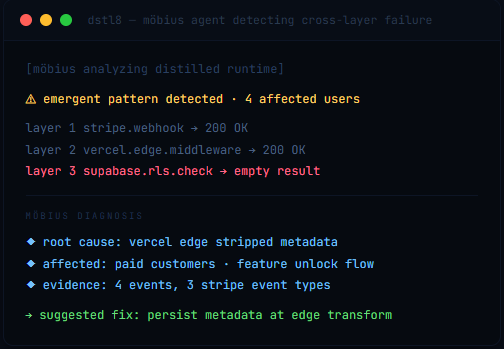
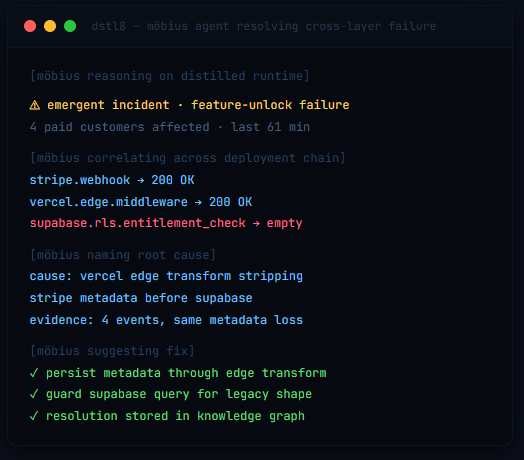
Its Möbius agent already flagged the pattern. Four customers with the same failure shape, all on the feature-unlock flow, all paid, all within the last hour. Root cause named with cited evidence: the Vercel edge middleware is stripping Stripe’s metadata before it reaches the Supabase query. Suggested fix: persist the metadata field at the edge, guard the Supabase query for the legacy shape. Fifteen minutes from alert to committed fix. The knowledge graph remembers. The next edge-transform bug takes three minutes.
Scenario: feature-unlock flow failure · Runtime surface: Stripe + Vercel + Supabase
Outcome difference: three hours of grepping → fifteen minutes of reading Möbius
TLDR
Three layers, one root cause. Möbius got there first.
Why Dstl8?
Continuous reasoning, cited evidence, compounding memory.
Continuous
Dstl8 distills your runtime the whole time, not just when you ask.
Distillation runs continuously across every layer you connect: patterns, samples, and anomalies, all current as of right now. When the alert fires, or the customer complains, or you just start looking, its Möbius agent already has the data it needs. No rules, no sampling windows, no cold starts.
Cited
Evidence behind every claim.
Möbius does not hand you a hunch. Every root cause links back to the patterns, samples, and anomalies that support it. You are reviewing a diagnosis, not starting one.
Cross-Layer
Your whole deployment chain.
Stripe, Vercel, Supabase, Railway, AWS CloudWatch, Kubernetes, OpenTelemetry, and more. Correlation happens across layers, not inside a single source. The seam where the failure lives is the first place Möbius looks.
Compounding
The knowledge graph makes your team smarter incident by incident.
When an incident gets resolved, the root cause and the fix land in the knowledge graph. The next time a similar pattern shows up, whether on the same engineer’s service or somebody else’s, the answer is already there. Your team stops rediscovering rabbit holes and starts compounding what you already learned.
Learn more
Related reading for the stack that burned you last time.
The rabbit holes you are skipping are specific to tools and platforms. These pages dig into the ones that show up most.
Common questions
What teams ask before adopting this.
Get started
Install & Configure Dstl8 in Under 2 Minutes.
Try the Dstl8 CLI and TUI for continuous runtime feedback. Install it, add sources, connect the MCP server into Claude Code, and more.
brew install control-theory/dstl8/dstl8
dstl8 signup
curl -fsSL https://install.dstl8.ai/script/dstl8-cli | shnpx dstl8nix run github:control-theory/dstl8Download from https://github.com/control-theory/dstl8/releasesQuick Start
# 1. Install the CLI
brew install control-theory/dstl8/dstl8

# 2. Create a Dstl8 account (or `dstl8 login` if you already have one)
dstl8 signup

# 3. Add a source so logs flow in
dstl8 sources add vercel

# 4. Connect your AI agent, auto-detects MCP-compatible clients on your machine and configures them
dstl8 install -all
dstl8 install claude-code
Add Sources
# Add Sources

dstl8 sources add kubernetes
dstl8 sources add cloudwatch
dstl8 sources add vercel
dstl8 sources add supabase
dstl8 sources add otlp
dstl8 sources add github
Start Here

See what’s actually happening.
Connect your deployment chain. Surface emergent patterns. Get root cause analysis with fix recommendations — right in your editor.
↻ Intelligence that compounds — every runtime signal makes the next one sharper.
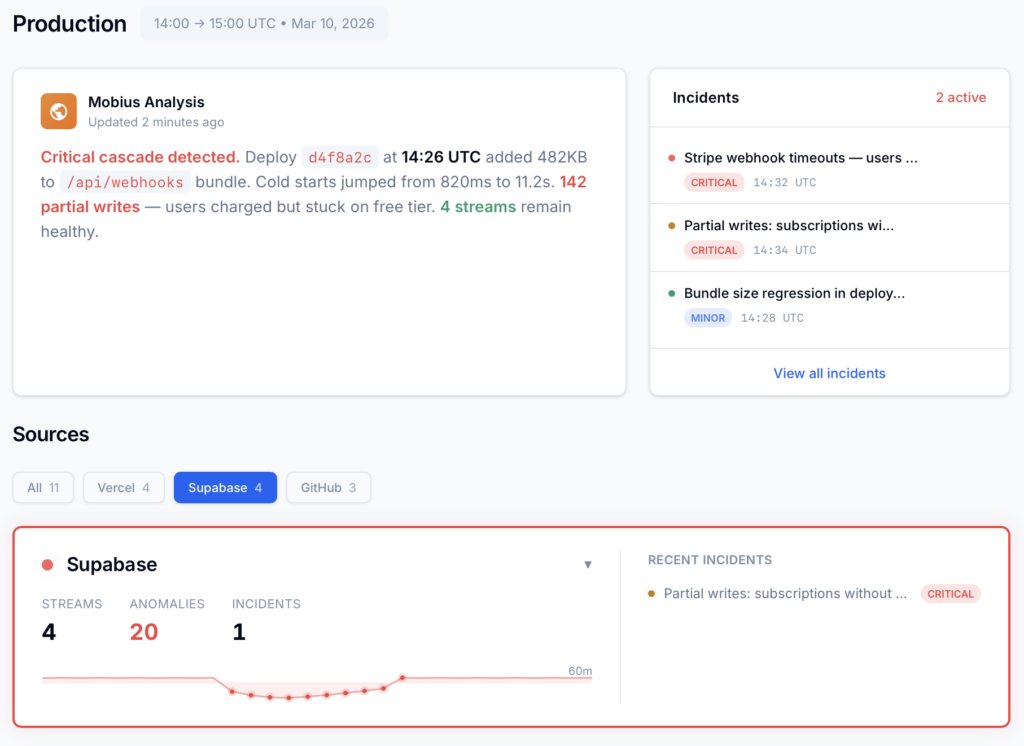
Dstl8 — Supabase runtime analysis

Open Source
Not ready for Dstl8? Start with Gonzo.
Free, open source log analysis TUI. Real-time charts, pattern detection, AI-powered insights — right in your terminal. No account, no config.
brew install gonzo
Find It Before Your Customer Does.
Free account. Connect your stack in minutes. Its Möbius agent starts reasoning on the first log, and the next emergent problem has a diagnosis waiting when you open the page.
Rabbit holes are optional now.
Dstl8 distills your runtime continuously. Its Möbius agent reasons on it. You get the fix, not the dig.