


Visit Booth 188 to see the AI SRE that doesn’t need an observability platform in action.
Salt Lake City, Utah, Nov 9, 2026. ControlTheory, creator of Dstl8, the telemetry-native AI SRE, today announced it is exhibiting this week at KubeCon + CloudNativeCon North America 2026 in Salt Lake City, November 9-12, at Booth 188. Company leaders will give live Dstl8 2.0 demos throughout the show.
Dstl8, which became generally available Sept. 22, finds, diagnoses, and fixes problems for development, platform engineering, and SRE teams shipping product on Kubernetes, OpenTelemetry, and AI-native platforms, working from telemetry it distills itself rather than data borrowed from an observability platform. Dstl8 2.0, launched today, extends Telemetry Distillation from logs to metrics and traces, now in preview, so Dstl8 can take on APM, follow AI workloads from agent to GPU, and predict problems before they hit.
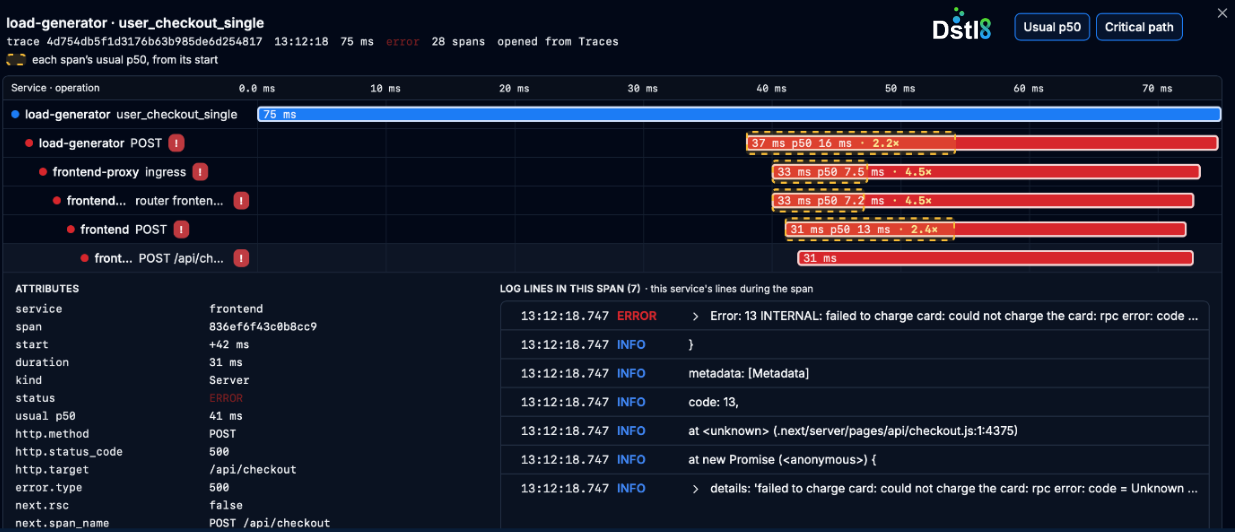
Most AI SREs wait for an alert, then reason over whatever an observability platform kept. Dstl8 starts with the telemetry: it applies Telemetry Distillation to continuously surface sentiment, patterns, anomalies, and severity close to the source, then reasons across topology, code graphs, and runtime signals to pinpoint problems in staging and production. It routes a diagnosis with cited evidence to the agent or engineer who shipped the code or manages the infrastructure, through MCP in tools such as Claude Code, Cursor, and Codex, for remediation.
Sentiment: A New Signal Dimension
Sentiment is a new signal dimension for the industry. Dstl8 reads the content, tone, and confidence of what a system is saying about itself, catching silent degradations that may never have tripped a standard threshold. Dstl8 works across Kubernetes, AWS CloudWatch, OpenTelemetry, Google Cloud, Supabase, Vercel, Railway, and more.
“AI native teams are shipping product faster than ever, creating new problems with agents, LLMs, and GPUs. That bigger blast radius takes an AI SRE that brings the telemetry it needs, not whatever an observability platform has on hand. At KubeCon, we’re demonstrating how Dstl8 does it: a signal distilled close to the source, a diagnosis delivered into the agent that shipped the change, and the loop closed from signal to fix,” said Bob Quillin, CEO and co-founder of ControlTheory.
Dstl8 Results
Early results point to the same pattern:
- An enterprise fintech customer running Dstl8 across 13 Kubernetes clusters saw 328 incidents resolved in its first two months, without writing a single alert rule.
- A global lender with a major application modernization project moving onto Kubernetes has seen 51 incidents detected and 44 resolved since going live.
Dstl8 builds on the momentum of ControlTheory’s open-source terminal tool, Gonzo, an MIT-licensed TUI (terminal UI) for real-time log analysis that has drawn more than 2,700 GitHub stars since its release last year. Where Gonzo is a local, single-session tool, Dstl8 is continuous, shared across a team, and built for the enterprise.
Signal to Fix
Since launch, industry coverage has centered on how Dstl8 gets from signal to fix. Analysts Paul Nashawaty and Samantha Weston of ECI Research described ControlTheory’s bet that the path from production back to the developer or agent is the missing layer of infrastructure: “the ability to route runtime intelligence back to the agent that shipped the code becomes a fundamental capability, not a nice-to-have.” Let’s Data Science detailed how Dstl8 caught a real production failure, a required field missing from some chat-session requests, and handed the evidence to Claude Code, which recommended a fix.
To set up an in-person demo at KubeCon, visit our scheduling page. For more on ControlTheory at KubeCon, visit https://www.controltheory.com/kubecon/. Start a 14-day trial at Dstl8.ai.
About ControlTheory
Founded in 2024 by observability veterans from StackEngine (acquired by Oracle Cloud) and CopperEgg (acquired by Idera), ControlTheory builds Dstl8, the telemetry-native AI SRE. Built on Telemetry Distillation, Dstl8 analyzes logs, metrics, and traces close to the source, finds root cause with zero alert rules, and delivers the fix to Slack, Claude Code, Cursor, and Codex, so teams don’t need a separate observability platform. ControlTheory also created Gonzo, the open-source OTLP terminal UI with 2,700+ GitHub stars. The company is based in Austin, Texas. Learn more at controltheory.com.
Media Contact
Jodi Bart Holzband
Classic Bart PR + Communications
Table of Contents
Telemetry-Native AI SRE
Dstl8 distills runtime signal at the source, routes the answer back to the agent or engineer to fix the problem.
 Back
press@controltheory.com