
Distilling Observability: Preparing for Dstl8

ControlTheory's "Distilling Observability" series explores how observability is evolving from raw data capture to continuous, intelligent understanding. Part 3 of the series looks at how Dstl8 turns noisy Kubernetes logs into clear, actionable signals with continuous, AI-driven distillation - see here for Part 2, and here for Part 1.
Most engineering teams collect far more telemetry than they can effectively use. They default to ingesting everything “just in case,” a habit that made sense in simpler systems. In Kubernetes environments, this approach backfires. Noise scales exponentially as clusters grow, adding nodes, pods, containers, and sidecars, especially with AI workloads.
The consequences are clear: query engines slow under load (assuming you know what to query…), dashboards take longer to render, and engineers spend valuable time waiting for results instead of resolving problems. Not to mention the storage costs that inevitably come with the amount of data you’re retaining.
Dstl8 changes the approach. It’s an observability distillation solution, powered by Möbius continuous AI log analysis. Built on OpenTelemetry standards, it operates seamlessly across development, staging, and production environments, plugging in to the logs you already have.
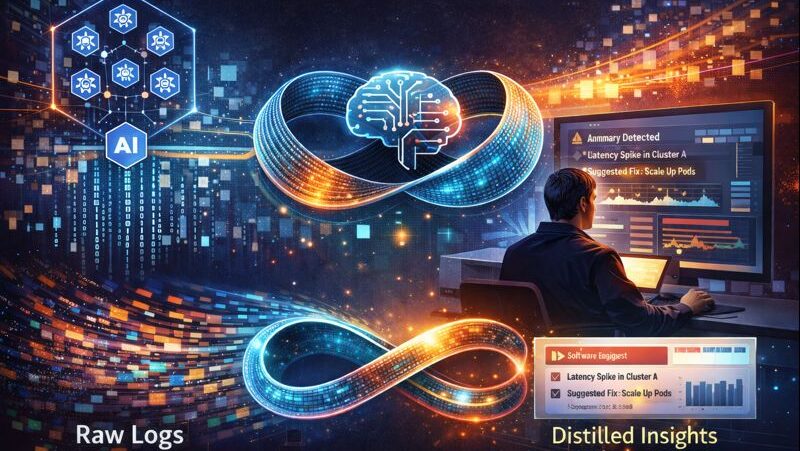
Rather than passively storing and searching raw telemetry, Dstl8 actively distills existing logs at the edge, correlates patterns across your entire system, and uses agentic AI to detect issues, explain anomalies, and suggest next steps.
Let’s walk through why signal-first observability matters to your team, how workflows evolve from Gonzo to Dstl8, and how to get the most out of our observability stack!
Who Benefits Most?
- Developers: Get real-time pattern detection and plain-English explanations directly in your terminal or IDE. Catch regressions early without leaving your workflow.
- SREs: Reduce incident response time dramatically. Möbius surfaces emerging issues with root-cause context before they impact users, leveraging the logs you already have…
- Platform Engineers: Lower telemetry costs and operational overhead while enabling clear, environment-wide visibility for your team, no more dashboard maintenance debt.
Traditional Observability: Noise Outpaces Insight
Many teams still follow a volume-first model, pushing all logs into systems like CloudWatch, Datadog, Grafana, Elastic, or Loki, then relying on those tools to handle the flood.
This works temporarily, but breaks down quickly in distributed systems.
The primary cost isn’t storage; it’s the computation (and knowledge) required to query massive, redundant datasets. Search engines scan gigabytes of repeated entries to find rare anomalies. Every dashboard refresh or ad-hoc query adds load, extending time-to-insight.
Kubernetes and AI workloads amplify the problem. A single service across replicas produces dozens of log variants. Add retries, verbose libraries, dependency churn, and high-volume LLM traffic, and raw volume explodes while useful signals remain buried.
The human impact is significant. High-volume telemetry increases cognitive load, prolongs debugging, and contributes to alert fatigue and operational toil. Complex custom query languages and learning curves leave developers searching for the proverbial “needle in the haystack”, let alone other stakeholders such as customer success, service desk, and others.
Dstl8 addresses this directly by distilling telemetry into essential signals at the source, integrating seamlessly with your existing tools.
Quick Takeaway: Collecting everything feels safe, but it slows investigations, increases human toil, and drives up costs. True clarity comes from distillation.
Why Log Distillation Matters Now
Log distillation processes raw telemetry at the edge. It identifies repeating patterns, suppresses duplicates, detects anomalies, and tracks shifts in severity, sentiment, and behavior. Critical events are preserved while redundant noise is eliminated.
This approach delivers three core improvements:
Higher Debugging Accuracy and Faster Insight
Distilled telemetry surfaces correlated patterns, trend shifts, anomalies, and sentiment changes as they emerge. Engineers no longer filter thousands of lines to find meaning. Instead, they receive narrative summaries that explain what changed, where it changed, and why it matters.
Lower Compute Load and Operational Cost
By suppressing repetition and retaining only high-value signals, distillation reduces the size of datasets downstream systems must index and scan. Query engines work on smaller inputs, dashboards stay responsive, and ingestion volume typically drops dramatically by 90+%, lowering infrastructure and compute spend.
Democratized Observability Across Teams
Distillation makes observability usable beyond query experts. Developers, customer support, service desk, and customer success teams can understand system behavior without writing queries or interpreting complex dashboards. Insights are presented in plain language and delivered directly into existing workflows, ensuring the people who first see an issue can understand what is happening without waiting on specialists.
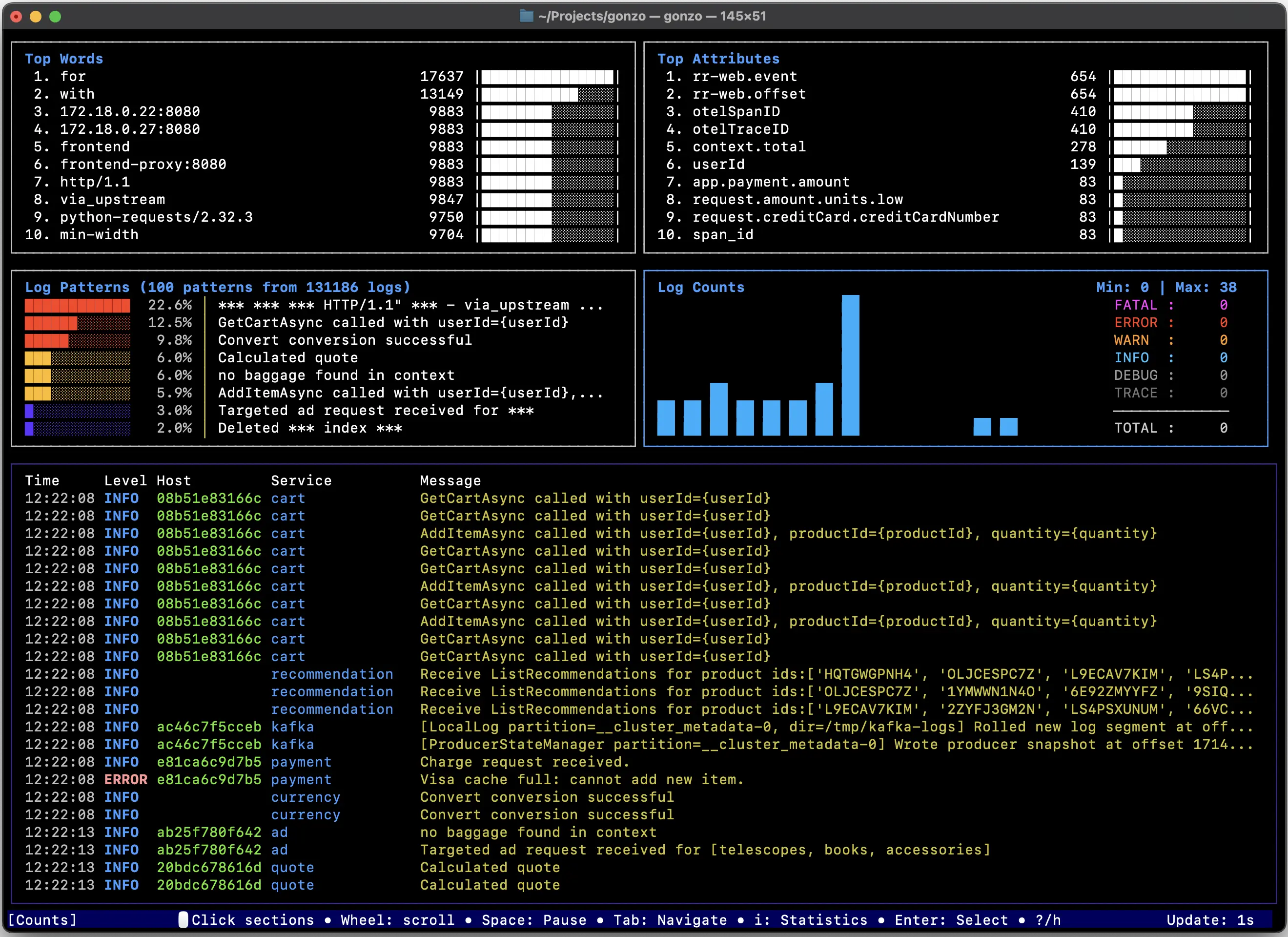
These principles drove Gonzo’s rapid adoption. Gonzo groups patterns, visualizes heatmaps, and tracks severity, matching how engineers naturally debug. Dstl8 extends this from local, ad-hoc analysis to continuous, always-on intelligence across your full environment, powered by Möbius multi-layer AI.
Distillation turns overwhelming telemetry into a clear, actionable understanding across teams, saving time, money, and frustration.
From Gonzo to Dstl8: Evolving Your Workflow
Gonzo introduced pattern-first, real-time log analysis in the terminal. It streams and auto-detects logs across multiple formats with native OpenTelemetry support, groups patterns, and highlights outliers with heatmaps and severity tracking, all with minimal friction.
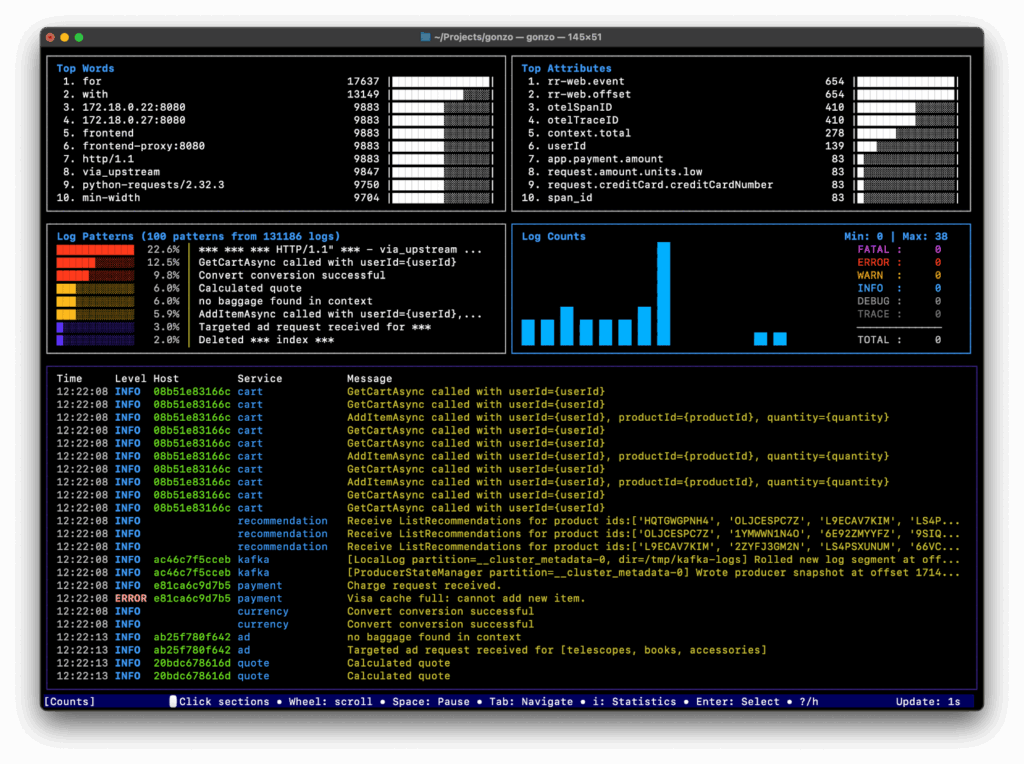
Dstl8 builds directly on Gonzo’s foundation, adding Möbius continuous AI for persistent, environment-wide coverage. It creates an adaptive observability control plane.
Here’s how the workflow advances:
- Patterns → Patterns, Correlations, and Sentiment – Gonzo groups logs locally. Dstl8 correlates those patterns across pods, services, namespaces, and clusters while tracking sentiment shifts that indicate behavioral change. This reveals emerging system-wide trends, regressions, and instability earlier.
- Heatmaps → Dynamic Localization and Drift Detection – Dstl8 visualizes where issues originate, how they propagate, and how they accumulate over time. Combined with sentiment and severity trends, teams can distinguish transient local glitches from sustained service-level degradation.
- Severity Tracking → Narrative Trend Summaries – Beyond counts, Dstl8 generates plain-English explanations of changes, impact, and evidence, catching regressions early.
- Local AI Hints → Agentic Context, Delivery, and Next Steps – Möbius agents continuously analyze distilled signals to generate root-cause hypotheses, impact assessments, and recommended actions.
These insights surface directly in the tools teams already use, including Slack, IDEs, terminals, and MCP-powered AI assistants. Engineers and operators receive context and guidance without switching tools, writing queries, or maintaining dashboards. The goal should be to have observability meet you where you are, whether that’s in your IDE or in the CLI.
Teams already using Gonzo are perfectly positioned. Dstl8 scales the same intuitive patterns, heatmaps, and insights into proactive, always-on coverage. Gonzo excels at real-time debugging right in the console, and Dstl8 makes that intelligence continuous, correlated, and explanatory.
How Dstl8 Works: Powered by Möbius Continuous AI
Dstl8 processes telemetry in three intelligent layers, running at the edge for maximum efficiency:
- Edge Distillation Layer – Analyzes logs locally to extract patterns, suppress redundancy, and summarize sentiment/severity, reducing raw volume before export.
- Correlation & Inference Layer – Aggregates and links signals across services and clusters, building contextual threads of system behavior.
- Incident Layer – Möbius agents continuously investigate anomalies, generate narrative explanations, and deliver actionable next steps.
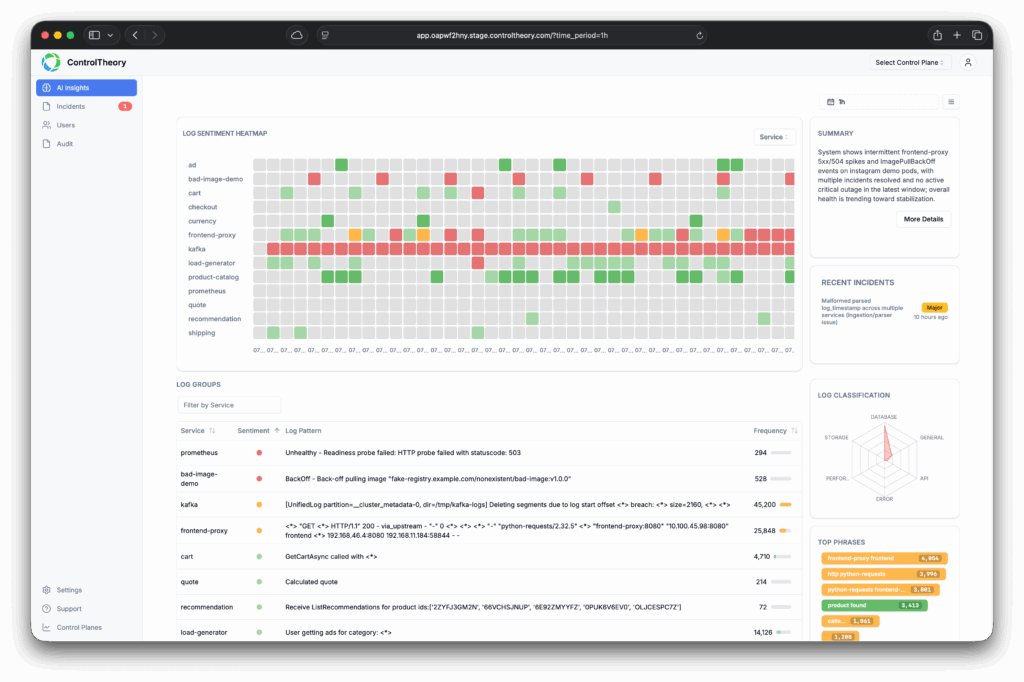
Insights flow into Slack, IDEs, terminals, webhooks, or dynamic dashboards, meeting engineers where they work.
Möbius turns raw logs into always-on understanding: distill at the edge, correlate across clusters, and continuously explain with agents.
What Your Workflow Looks Like with Dstl8
Once Dstl8 is deployed alongside your existing pipeline, your daily work improves significantly without requiring major behavior changes:
- Keep emitting and shipping logs as usual. Dstl8 automatically distills them at the edge, delivering patterns, heatmaps, and plain-English summaries directly to your terminal, IDE, or Slack.
- Resolve incidents faster and more confidently. Möbius agents surface emerging issues proactively with correlated context, evidence, and suggested fixes often before users notice, using AI log analysis.
- Gain full-environment clarity with less effort. Dynamic correlations and explanations highlight drifts, hot spots, and regressions across clusters, no more chasing ghosts in raw data.
Dstl8 augments how you already work, turning noise into proactive intelligence with minimal disruption.
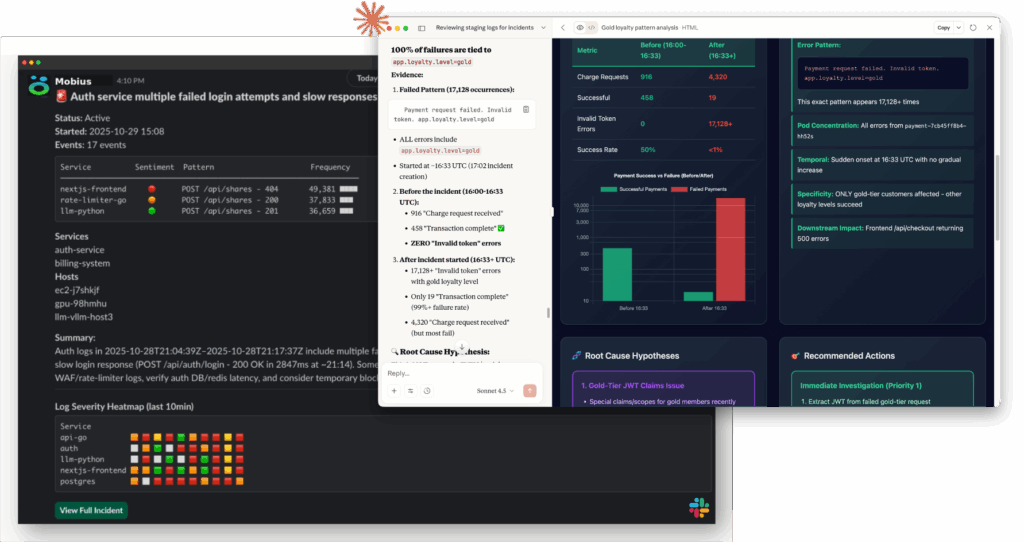
What Advantages Come with Continuous Distillation for AI Log Analysis
Incident response transforms first. Möbius detects and explains anomalies as they emerge, shrinking MTTR and preventing many outages entirely. Manual searches and static dashboards fade. Teams rely on narrative summaries, agentic insights, and dynamic visualizations delivered proactively.
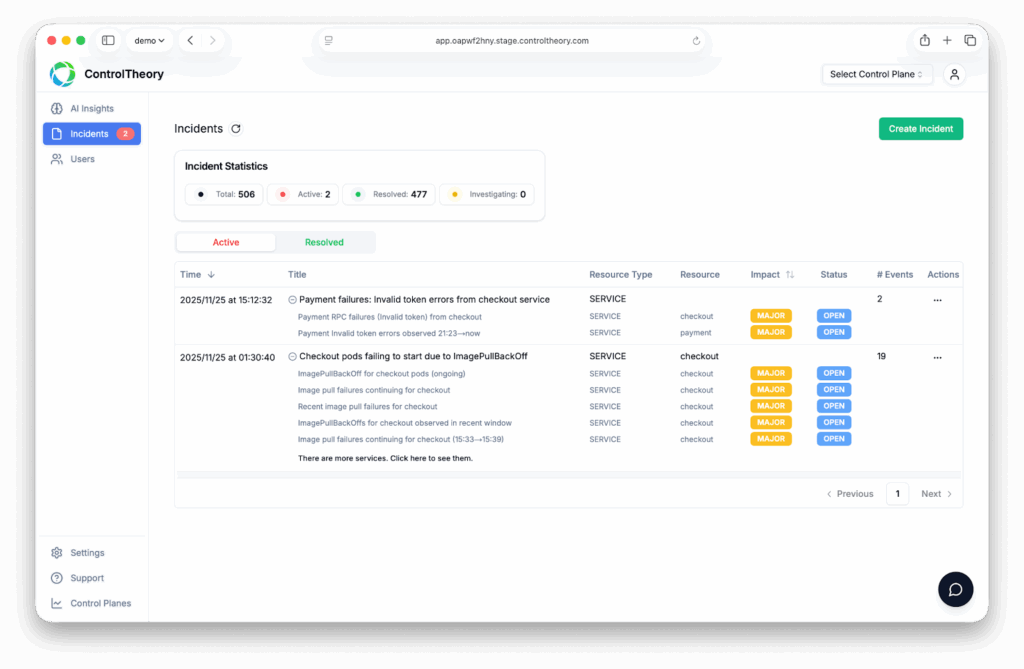
Feedback loops tighten across development and operations. Less noise reaches downstream systems, costs drop, and engineers focus on building rather than wrangling telemetry. Observability evolves from reactive searching to proactive continuous understanding.
True Observability Requires Continuous Intelligence
Cost reductions matter, but the real value is clarity and control, actively shaping telemetry into actionable insight. Dstl8, powered by Möbius continuous AI log analysis, delivers this by distilling at the edge, correlating across environments, and explaining changes in real time.
The result for Dstl8 users is faster debugging, lower costs, reduced toil, and dramatically clearer system understanding across teams.
Dstl8 public preview is now live. Deploy it alongside your current tools today and experience continuous, signal-first observability.
Table of Contents
Surface Unknown Unknowns Automatically
Catch emergent patterns from AI-generated code in staging—before they become production incidents.
Learn About Dstl8 Back
Back


press@controltheory.com