


Why emotional intelligence for machines (log sentiment) might be the sneaky superpower your observability stack is missing.
Engineers love precision. Numbers. Counters. Histograms. Distributed-trace-powered Rorschach tests. We pile metrics on logs on traces on heat maps (ok, heat maps are cool) until the whole stack looks like a NASA command center.
Logs – those humble little diary entries your services whisper into the void – carry emotional weight. Every “failed to”, “could not”, “retrying”, “timeout”, is a mood. And that mood matters.
If you can understand the sentiment of your logs, you can understand a shocking amount about the health of your system. Not everything – sure, nothing but death and DNS outages are absolute – but sentiment gets you surprisingly far.
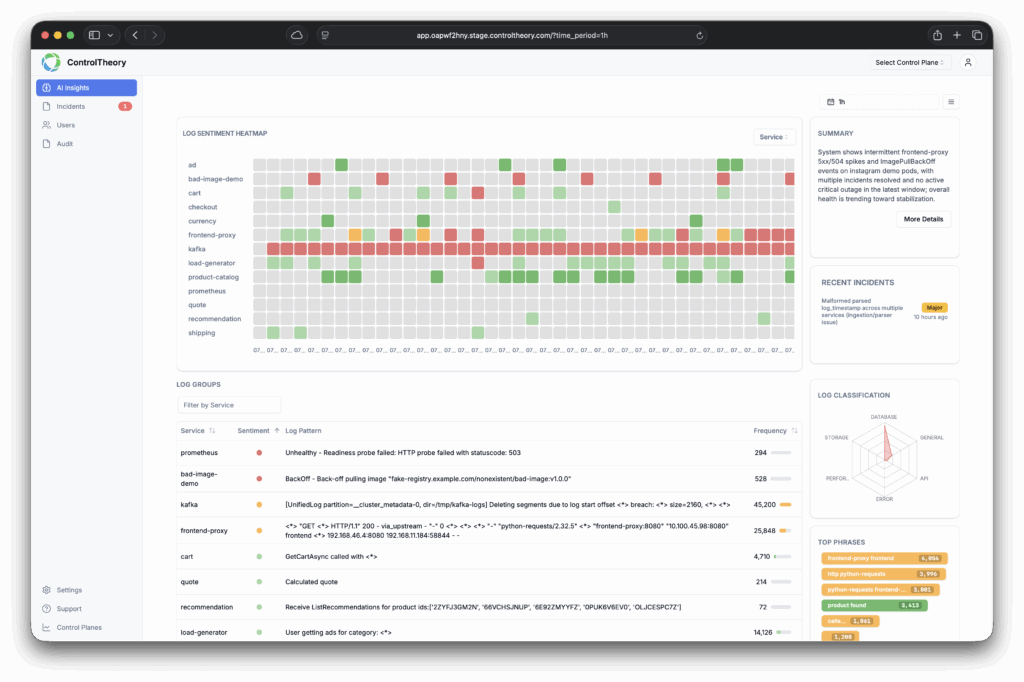
We saw this first hand at KubeCon 2025 in Atlanta, when we were demoing our new product, Dstl8, which distills log data and looks at the sentiment of every single log message.
Let me explain.
Most failures show up as tone before they show up as metrics
Machines are not poets, but they absolutely communicate distress.
Before latency spikes?
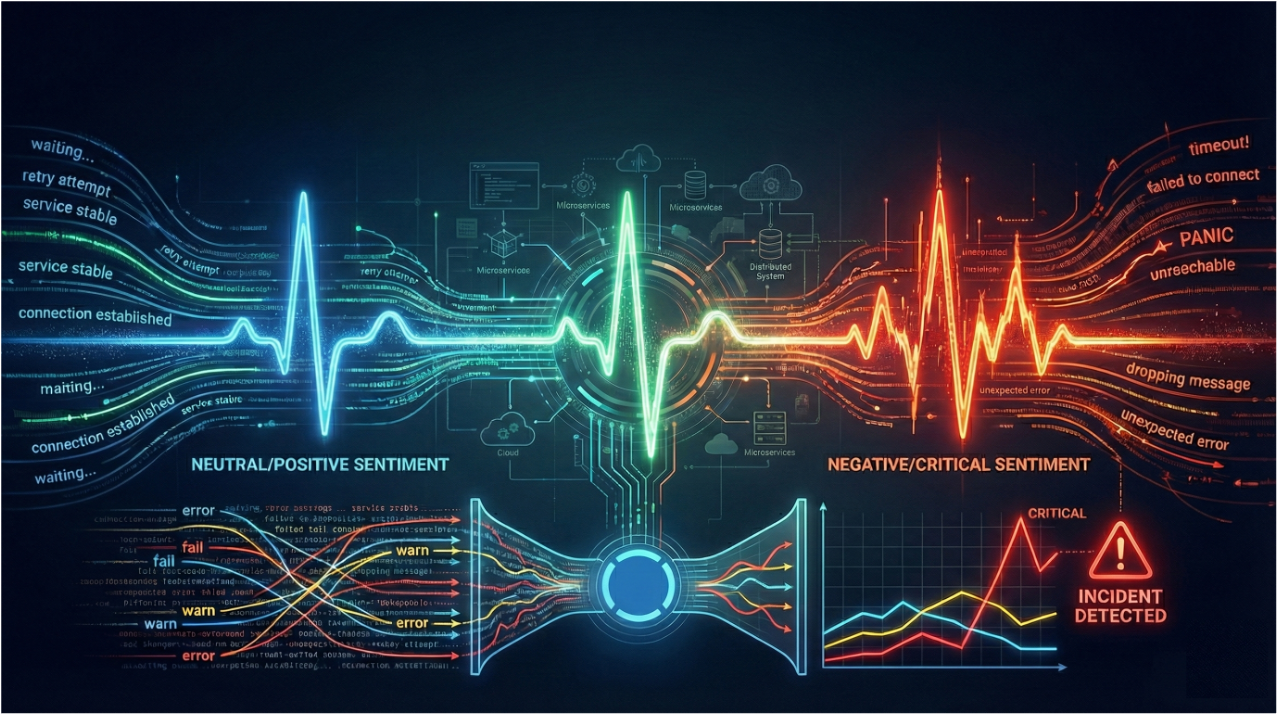
Logs start sounding nervous. Lots of “waiting”, “retry attempt”, “falling back”, “timeout”.
Before a misconfiguration faceplants a deployment?
You’ll see logs saying things like “invalid”, “unexpected”, “unmarshaling error”, “dropping message”.
Before an outage?
The logs go full emo: “failed”, “cannot”, “panic”, “unreachable”.
Metrics tell you what is happening. Logs tell you how it feels.
And that emotional trajectory, that system-wide mood swing, is the best early-warning signal many teams completely ignore.
Sentiment analysis turns chaos into structure
Raw logs are a landfill. Sentiment is recycling.
When you classify logs by emotional weight (positive, neutral, negative, critical) you transform millions of text lines into a few understandable curves. Suddenly you’re not drowning in string matching or regex hacks – you’re watching the emotional heartbeat of your system in near real time.
Spike in negative sentiment?
Something is degrading.
Sustained neutrals?
Probably business as usual.
Sudden crash into critical sentiment?
Grab a fresh cup-o-coffee and buckle up, it could be a long day.
And because sentiment collapses complexity into a simple signal, you can watch the entire stack – infra, services, APIs, queues, lambdas – from a single angle without losing the forest for the trees.
“But log sentiment can’t possibly replace real observability!”
Correct.
Nobody said it should.
This is the part where the pedants will crawl out of their bastions of Grafana dashboards to tell you that sentiment is reductive, imprecise, lossy, and insufficient for true root cause analysis.
Fine.
But sentiment isn’t meant to replace your metrics and telemetry – it makes them better. It’s the smoke alarm, not the fire inspector. The hell of modern observability is that we try to investigate every blip, spike, and bump like it’s a federal investigation. We collect everything and sift through it later.
Sentiment is triage.
Sentiment tells you where to look.
Sentiment stops you from going blind in the noise.
Why log sentiment goes further than you’d expect
A few practical reasons this isn’t just armchair theorizing:
- Logs are emitted exactly when things happen. Metrics rely on intervals. Logs fire immediately. Sentiment catches the slope before the cliff.
- Logs preserve linguistic intent. Humans encoded the meaning. “Error connecting” carries more signal than a single counter tick.
- Sentiment plays beautifully with AI summarization. If you want LLMs to help interpret system behavior, grouping by sentiment gives them context and focus.
- Negative sentiment clusters correlate almost perfectly with incidents. It’s uncanny. Like cheat-mode uncanny.
- It bridges the gap between humans and machines. Because sentiment is human-shaped (I mean, WE wrote those logs in the first place), it supports debugging conversations:“Why’s checkout down?” → “The services got grumpy at Redis around 14:03.”
The punchline
Log sentiment isn’t literally all you need.
But it’s the 20% that gives you 80% clarity.
It’s the flashlight beam that cuts through the log fog.
It’s the high-level bird’s-eye mood of your infrastructure – a way of seeing the system’s emotional signature.
When you plot sentiment over time, you’re effectively watching your platform’s nervous system light up. And the more complex your architecture gets – microservices, multi-cluster, multi-cloud, distributed chaos – the more valuable that simplicity becomes.
Sentiment is a compass in the wilderness.
 Back
Back


press@controltheory.com